Sunday, July 25, 2010

Antiquariana: Old England in 3-D


When I worked for a rare photography collector, I came to know a few images by the stereoscopist and chronicler/artificer of 19th-century British village life, T.R. Williams, while flipping through the Encyclopedia of 19th Century Photography. But the Encyclopedia tends not to mention things like the fact that one of the foremost aficionados of Williams' stereoscopic views is Brian May, guitarist for Queen. Apparently May has just published a book about Williams and his elaborately constructed three-dimensional idylls. New York Times article here.

Thursday, July 22, 2010

The Vampire Thing Never Dies: Ceasescu Exhumed

This is possibly the first in an ongoing series of observations about the vampire thing and how it never dies. Then again we are all sick of vampires at this point.

Yesterday the New York Times announced that the remains of Nicolai Ceausescu and his wife were being exhumed to prove that they had been buried where people thought they had been buried after their executions under dubious circumstances in 1989. Some Romanians, including Ceausescu's children, suspect that the couple were not buried in their official graves.


As Romania's dictator for twenty-five years, Ceausescu ruled with an iron fist and favored isolationist politics, keeping the USSR out of his country. The medieval Romanian prince Vlad Tepes ("The Impaler") held a strange fascination for Ceausescu. Vlad, who sometimes called himself "Dracula," is most famously remembered as the very loose inspiration for Bram Stoker's Romanian vampire count of the same name. But among Romanians he was remembered as a ruler with an iron fist who favored isolationist tactics, keeping the Turkish Empire out of his country for most of his rule. Ceausescu worked hard to make Vlad a national hero in his own image, and to make himself a national leader in Vlad's image. He ordered a nation-wide observance of the five-hundredth anniversary of Vlad's death in 1976, and issued stamps bearing Vlad's image. As he fled the mobs that threatened his life in 1989, Ceausescu took refuge in the village of Snagov, where Vlad is said to have been executed and buried under dubious circumstances in 1476. (The location of his grave is still a matter of debate, and attempts to settle the matter through exhumation have proved unsuccessful.)

It should be noted that in European folklore, a vampire could usually only be identified by exhuming his or her grave. A body that had not decayed naturally was presumed to be a vampire.

Some choice quotations from the Times article:

Ceausescu's alleged remains were better preserved than those of his wife...
....
Ceausescu was toppled Dec. 22, 1989, as Romanians fed up with years of draconian rationing and communist rule revolted. He tried to flee Bucharest by helicopter but his pilot switched sides. After a summary trial, Ceausescu and his wife were executed by a firing squad three days later.

Oprean's wife, Zoia Ceausescu, had sued the defense ministry in 2005, saying she had doubts that her parents were buried in the cemetery. She died of cancer in 2006 and her brother Valentin took up the case. The couple's other son Nicu died of liver cirrhosis in 1996 and is buried in the same Ghencea cemetery.
....
Ceausescu was also known for the fierce way he stifled dissent with his Securitate secret police, which were believed to have 700,000 informers in the nation of 22 million.
 ....
Aurel Chiubasu, 66, a former carpenter in a military unit, heard about the exhumation and rushed over to tend his wife's grave nearby.

''I didn't agree with him being executed but the family has the right to know where he was buried,'' he said. ''People speak like it's not him there and he's buried somewhere else."

Monday, July 19, 2010

Mexico City: Scenes—New Sounds

I haven't posted anything in a while because I was working on a sound-and-word project (you could probably call it "music") with my brother. In a bit of a role reversal, he made the words and I made the music. But now it's finished and it will be featured as part of a group arts show that a friend in Brooklyn is organizing. It's this Friday. You should go. Yes, you.


The Davis Brothers' contribution to the show is three short word-and-sound pieces (vulgarly referred to as "songs"), with texts by my brother about Mexico City, and music by myself that mostly consists of sounds I recorded on the streets here.

Hopefully I will get back to posting more soon. However, for those of my avid readers who  thirst for more, slake yourself below on some pics from a recent trip to Teotihuacan.

Elsewhere in Mexico: Teotihuacán

Click for larger images.

What it all looks like.

 
Map so you don't get lost on the Avenue of the Dead.

 
Guy selling bows and arrows.

Flora.

I didn't go there.

Guy descending pyramid.

Another guy selling bows and arrows. Hunting is big with the Teotihuacán crowd.

 Pyramid of the Moon.

Friday, June 25, 2010

Related

I have been informed that it is now summer in the US. Here in Mexico City it does not feel like summer, because it never does not feel like summer.

Tuesday, June 22, 2010

Mexico City: Dialogues


It's the rainy season here, which means it pours intermittently between about 5 and 9 pm every evening. Yesterday I took refuge in a taco joint for about two hours while the streets around me turned into ponds. I was the only customer there. One young waiter would occasionally peer out from under the tarpualin and shout, "Tlaloc! Qué pasa, Tlaloc?"

Thursday, June 17, 2010

Mexico City: Scenes—Portales Market


Everyone's a Critic: Dylanology


Dylan:           That song sure as hell wasn't written for you.
Weberman:  It wasn't?
Dylan:          It sure as hell wasn't, no. I was not even aware of you
                     at that time.
Weberman:  Isn't 'landlord' 'critic,' though, in your symbolism?
....
Dylan:           If you took some of that energy and spread it out a little,
                      you could get involved in a whole new thing.
Weberman: Dylanology's working out fine for me.
Dylan:          Well I don't know if there's going to be enough there.

—from a phone conversation between Bob Dylan and "radical" music critic/journalist Alan J. Weberman, taped June, 1971

Tuesday, June 15, 2010

Spanish Lesson/Adventures in Rhythm: Rasguenda las Cuerdas

In an attempt to improve my Spanish I started listening to a lot of flamenco. This turned out to be not very productive: Flamenco is usually sung in a gypsy argot with an intense Andalusian accent, where the S's are dropped and the vowel at the end of a word always sounds like 'oowwww'. It's like trying to learn English by listening to delta blues.


Anyway this clip features some great flamenco singing, dancing and guitar playing (I think it's a tangos) in a festive setting—although in Arabic instead of Spanish. But it's also notable for a couple of cross-cultural connections. The melody here comes from an old Spanish/Moorish song (there's some debate about this), of which there are versions in Spanish and Arabic. Part of it was used by the Gipsy Kings in their more famous song, 'Viento del Arena.' (The Gipsy Kings are in fact Spanish gypsies, but from families that were displaced to southern France during the Spanish Civil War.)

The beautiful young woman who sings and dances here is Lole Montoya, later the singer for Lole y Manuel, the duet that inaugurated the flamenco nuevo movement of the 1970s. Quentin Tarantino used one of their songs, 'Tu Mira,' in his more famous Kill Bill 2.

(By the way, if anyone knows more about the song behind this and 'Viento del Arena,' please tell me. I know nothing. Also, there's definitely some Michael Jackson stuff going on in her dancing.)

Saturday, June 12, 2010

Antiquariana: The Yankees of Old Weathersfield


"The most prominent of these was a certain rambling propensity, with which, like the sons of Ishmael, they seem to have been gifted by heaven, and which continually goads them to shift their residence from place to place, so that a Yankee farmer is in a constant state of migration, tarrying occasionally here and there, cleansing lands for other people to enjoy, building houses for others to inhabit, and in a manner may be considered the wandering Arab of America....
"...while the renowned Wouter Van Twiller was daily battling with his doubts, and his resolution growing weaker and weaker in the contest, the enemy pushed farther and farther into his territories, and assumed a most formidable appearance in the neighborhood of Fort Goed Hoop. Here they founded the mighty town of Pyquag, or, as it has since been called, Weathersfield, a place which, if we may credit the assertions of that worthy historian, John Josselyn, Gent., 'hath been infamous by reason of the witches therein.' And so daring did these men of Pyquag become, that they extended those plantations of onions, for which their town is illustrious, under the very noses of the garrison of Fort Goed Hoop, insomuch that the honest Dutchmen could not look toward that quarter without tears in their eyes."

-Washington Irving, A History of New York: From the Beginning of the World to the End of the Dutch Dynasty, by Diedrich Knickerbocker, 1809

Wednesday, June 9, 2010

Elsewhere in Mexico: Art Deco Jesus

Church, Acapulco.

Stranger with You: The Accountants Have Computed


The pace of life is more relaxed in Mexico. That means it takes fifteen minutes to pay for a cup of coffee. Maybe this will change as they open more Starbucks franchises.

Mexico City: Scenes

Mexico City metro stations are inordinately large. The corridors seem designed to admit a military procession or a running of the bulls. It often takes five to seven minutes of hard walking to make a simple transfer between lines. Probably to compensate for this, the trains are too small.

The trains run on rubber tires and are very quiet when they pull up to the platform, but are less quiet inside, where the windows are left open due to a lack of air conditioning.

On the Street: Guitar

Calle Cozumel.

Tuesday, June 8, 2010

Mexico City: Scenes

Guy at a party.


Lucha libre poster (unrelated).


My neighborhood by day...


...and by night.


Not my neighborhood.


Centro Historico.

Centro Historico.

Wednesday, June 2, 2010

Adventures in Rhythm: With a Different Meaning

How did I never notice that the Rolling Stones stole the hook for "Under My Thumb"...


from the Four Tops' "Same Old Song"?


Keith's miming is all original though.

Saturday, May 22, 2010

Stranger with You: Return of the Space Cowboy


I am sitting at my kitchen table and someone in the courtyard is drunkenly singing "Like a Stone." In Mexico City, you hear a lot of pop music that isn't played publicly in New York City anymore. Audioslave is a good example. I've had several unexpected chances to reacquaint myself with their early-2000s hits. Jamiroquai is another. I've heard more Jamiroquai during the last two months than I had during the previous five years in New York. In Mexico City it is perfectly acceptable to play "Cosmic Girl" at a party, bar, cafe, or from your car stereo as you cruise Avenida Insurgentes with the windows  rolled down. That kind of thing doesn't happen often in New York. To give another example: when was the last time you and your buddies were hanging around drinking beer and someone played three songs in a row by Massive Attack? Here it's common.

Friday, May 21, 2010

Mexico City: Scenes

 
Mexico City is justly famous for its many murals...

...which capture the spirit and history of the Mexican people...

 
...in all their nuances.

Funny Things About Serious People: Three for Papa


"Among the last of the species was big, curly-haired, broken-nosed Lionel Moise, a brilliant reporter who was also a poet, a cop-slugger, a heartbreaker, a singer of barroom ballads, and a great teller of barroom stories. He liked to start a story by saying, 'Did I ever tell you about the time I was in jail in Pocatello [or Fresno or Savannah]? I was but a lad...'....Besides telling stories, he liked to stand with his foot on a brass rail and discuss the art of writing fiction.

"I knew him first and best in 1919, when he was working briefly for the New York American....Much as I liked and admired him, I thought he was one of the many brilliant reporters of the time who had half-baked themselves by reading Nietzche....He could be cruel to women, and one year in Chicago there were two attempted suicides because of him....He had talent enough to have become a famous writer too, if he had ever acquired the discipline of the trade. As it was, he exerted a real influence on American writing, through the cub reporters who learned their jobs under him....I learned that Moise had worked for the Kansas City Star in 1917, when Hemingway was a cub there and listened to his lectures. 'Pure objective writing,' Moise would say time and again, 'is the only true form of story-telling.'"
-from The Literary Situation, by Malcolm Cowley, 1958


"Back in August, when the 4th Division was sweeping eastward from Normandy, Hemingway ranged ahead of it in his jeep and began making contact with the French irregulars. He was an imposing figure...The French were convinced that he must be a general, but Hemingway told them he was only a captain.

"A guerrilla asked him, 'How is it that a man so old and wise as you and bearing the scars of honorable service is still a captain?'

"'Young man,' Hemingway answered...'the reason is clear and it is a painful one. I never learned to read and write.'"
-from "A Portrait of Mister Papa" in Life, by Malcolm Cowley, 1949


"Then it rained hard on the dead wet leaves. And you knew that if you said it all truly there would be enough there for a long time. Enough of the olives and Baked Alaska when the air conditioner blew at you hard in the fine little room behind the zinc of the bar at Sardi's. Nick stood up and hit the waiter hard just below the temple. The man went down. The cool red borscht flew from his hands and spilled into rivulets. Three waiters came at us and you put the empty champagne bottle to your cheek and popped them down as they moved fast coming at you with a sudden rush. Hi ho, said Mary, as you counted the saucers and left a tip although you were poor. If it were true enough it would all be there. It would all be there if you said it truly."
-from The Adventures of Mao on the Long March, by Frederic Tuten, 1971

Tuesday, May 18, 2010

On the Beach


It recently occurred to me that I've now been to the Pacific coast twice in Latin America, but never in the United States.

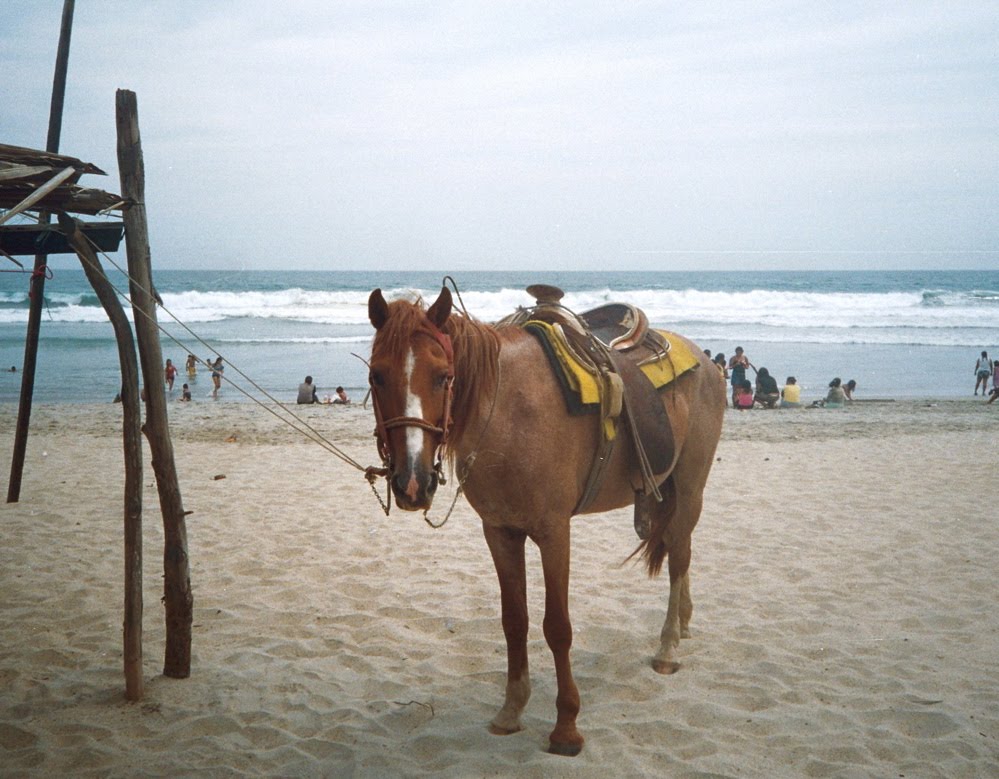
Below are some pictures from a trip last month to a small beach in Guerrero called Boca del Rio (not the famous one).